Five young leaders (from the Uniting Church in Australia) travelled to Thailand in April to participate in the Fifth Asian Ecumenical Youth Assembly (AEYA 2026), a significant regional gathering of emerging Christian leaders.
Hosted by the Christian Conference of Asia, the AEYA 2026 met under the theme “Break Every Yoke” (Isaiah 58:6).
The delegates represented not only the Uniting Church in Australia but also the National Council of Churches in Australia and the Victorian Council of Churches, reflecting the breadth of Australia’s ecumenical partnerships. The group included Sione Hehepoto from the UCA Synod of Victoria and Tasmania.
AEYA-2026 invests in young adults: deepening relationships across Asia and the Pacific, listening to one another across cultures, and contributing as an active ecumenical partner to a region wrestling with shared questions of climate, migration, justice and faith. Through this gathering, participants had the opportunity to deepen relationships, share experiences and contribute to a collective ecumenical witness. The gathering served as a reminder that faithfulness calls us beyond our own borders, and that solidarity with our neighbours near and far is not optional but Gospel.
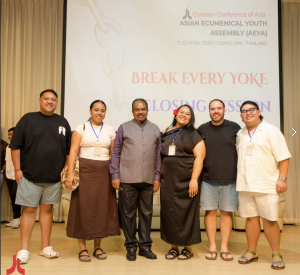
Here is Sione Hehepoto’s reflection (on the left of the photo above):
Participation in the Asian Ecumenical Youth Assembly (AEYA) was experienced not simply as an opportunity, but as a profound moment of calling – one that carried both privilege and responsibility. There was a deep awareness that attending such a gathering meant representing more than oneself; it meant embodying, in some small way, the voice and spirit of the Uniting Church in Australia. This awareness cultivated a posture of humility, alongside a desire to listen attentively and engage authentically with others.
What proved most striking throughout the Assembly was the diversity and depth of experiences shared by young people across Asia. Conversations were not abstract or theoretical; they were grounded in lived realities marked by economic inequality, forced migration, political repression, ecological crisis, and the everyday pressures shaping young lives. These stories challenged any tendency toward complacency. Living in Australia often affords freedoms – of speech, worship, and movement – that are not universally guaranteed. For many at AEYA, even peaceful protest involves significant personal risk, and for some, digital spaces become the only viable means of expressing dissent.
Yet, alongside these differences, there emerged a profound sense of shared struggle. The issues discussed were not confined to one region but resonated across contexts, including the Pacific and Australia. This realisation disrupted simplistic binaries between “here” and “there,” instead revealing a deeply interconnected world where injustice and hope coexist across borders.
One particularly meaningful conversation took place with a delegate from Indonesia, who raised questions about navigating patriarchal gender roles within the family. In response, there was an opportunity to reflect on a lived experience where traditional expectations had been reimagined: a household in which the mother serves as the primary breadwinner, and the father, living with a disability, takes on caregiving responsibilities. This exchange highlighted that relationships are rarely defined by rigid equality but are better understood as dynamic and adaptive – like a dance, shaped by mutual support and shared commitment. At its core, genuine love resists ego and invites a reordering of roles for the sake of the other.
Being invited to lead small-group Bible studies added another layer to the experience. While this role carried a sense of responsibility, it quickly became clear that facilitation was less about imparting knowledge and more about creating space for collective reflection. In this context, learning was mutual. The insight that “I received far more than I gave” captures the transformative nature of these encounters, where the Spirit was discerned not in authority, but in shared dialogue.
More broadly, AEYA reshaped an understanding of ecumenism. It was no longer simply about institutional unity but about connection across difference – standing in solidarity with those on the margins and engaging actively in the struggle against injustice. This has significant implications for ministry. It calls for intentionality, courage, and a willingness to use one’s voice in public ways.
As formation draws to a close, ministry is increasingly understood not as something confined to church settings but as a way of life expressed in everyday interactions. It is inherently public – a proclamation of Jesus Christ that is embodied in action as much as in word. Central to this calling is a commitment to listening, particularly to young people and those whose voices are often overlooked.
Ultimately, the experience of AEYA reinforces a fundamental conviction: that gifts, privilege, and influence are not for personal gain, but for the service of others. To honour those encountered is to live faithfully, truthfully, and with love – a commitment that continues to shape both ministry and life.
(Adapted from an article by Amelia Lavaki and Christian Conol)