Categories
Sandy's Comments

Causing a ruckus

Archbishop Peter A Comensoli delivered the following homily at St Christopher’s Syndal on Sunday 14 August 2022, at a Mass to celebrate the 60th anniversary of St Christopher’s parish and the opening of new parish buildings.

Causing a ruckus – in the name and way of Jesus Christ

It is not easy being a Catholic Christian these days in the Central American country of Nicaragua. Nicaragua is one of the poorest and most corrupt nations in the world. While technically a democracy, it has been ruled over by a quasi-dictator president for several decades. It is a country that imprisons its political opponents and journalists, its business leaders and members of civil society who voice opposition, and it attacks freedom of expression across the country.

Two weeks ago, a bishop of a diocese in Nicaragua, Bishop Rolando Alvarez, along with six priests and six lay leaders, was locked inside his parish house and placed under armed miliary guard. His crime? He sought to protest the forced closure of several Catholic radio stations in the country, and accused authorities of using media and social networks to carry out acts of violence against the population. 

Bishop Rolando Álvarez, Nicaragua

His protest was going to be to celebrate a public Mass with the faithful, and to have a Eucharistic procession. Hardly a radical protest – peaceful, prayerful, gentle. While imprisoned in his home, he has been streaming Mass on Facebook Live, and offering simple messages of hope and encouragement to his people. He also makes a daily visit to the front gates of his compound, where he says a cheery hello to his armed miliary guards and sings religious songs to them. I like this bishop!

Public prayer – celebrating Mass, having a procession, saying the rosary – can be a radical action when accompanied by the striving for justice and goodness in God’s kingdom. Giving public expression to God’s justice and mercy in the world, and standing with Jesus in solidarity for the poor and persecuted, is a deeply Catholic thing to do. As Jesus announced in today’s gospel, ‘I have come to bring fire to the earth’. But the manner in which this is done also needs to be peculiarly Christian: without attack and denigration, but with the spiritual power of prayer and the peaceful action of solidarity. Violence will beget violence, and any protest that is violent in idea or word or deed is far from the kingdom of God.

When Christians gather to pray on any given Sunday (as you have been doing here at St Christopher’s for the past 60 years), we do so publicly. It is a statement to the world that the way of Jesus Christ, given expression by the gathering of his disciples, is a gift of hope for all, and a blessing among people. Our common worship on a Sunday is always a radical thing, even if it feels ordinary, or a chore, or even mundane. It is radical because it witnesses to a group of people striving to live a different way in our culture. We are saying something to the world when we gather as God’s people in prayer (even when we are doing so in an ordinary suburban setting like Syndal).

Bishop Alverez and his 12 companions are doing nothing other than to pray in solidarity with and for their people, in some run-down looking house in the hills of a far-distant country, Nicaragua. Yet, it is such a radical and good thing that they are doing. Peacefully, prayerfully, gently – yet with determination and a cheerful manner – they are working for God’s kingdom to change lives for the better. They are certainly causing a ruckus, even division, among the powerful elite. They are making a mess in the name and way of Jesus Christ; and good for them. The great news is that we can do the same, in Christ’s name.

Source: Melbourne Catholic

Categories
News Sandy's Comments

Anglican Bishops & Lambeth

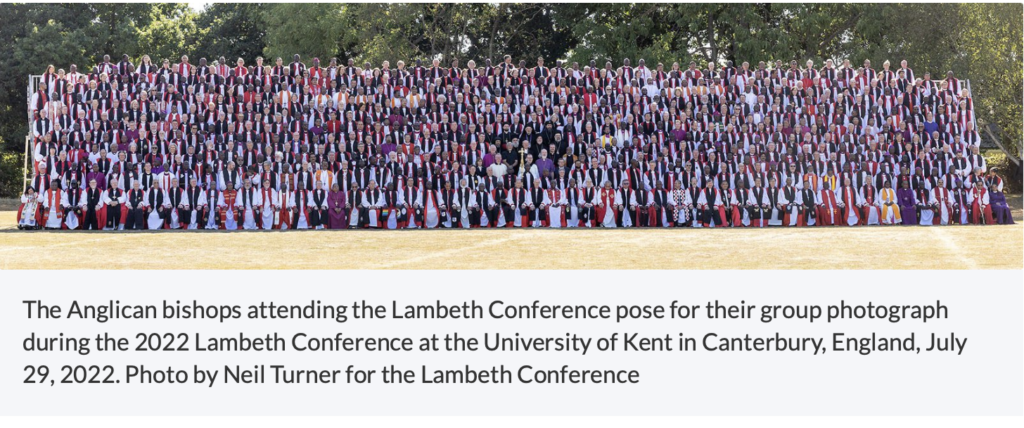
The Australian bishops present at the Lambeth conference 2022 celebrate the support of the bishops called together by the Archbishop of Canterbury for the Lambeth Conference 2022 for the ‘Statement of Support regarding Indigenous Peoples in Canada and around the world’.

The Statement recognized and regretted the impacts of colonization that ‘stripped Indigenous peoples of their agency, identity, languages, cultures and governance; colluded with the Doctrine of Discovery (in the Australian context, the aspirations and impact of British imperialism), including corrosive government policies; denigrated their spiritual heritages; prohibited ceremonies and stole their land’. We also acknowledge that many First Nations peoples rejoice in the gift of the Gospel of Jesus Christ and now serve the church in leadership throughout Australia.

With deep repentance the Australian bishops present at Lambeth 2022 recognize that the Anglican Church of Australia colluded in the above and within our own history aided the forced removal of First Nations children from their parents (the Stolen Generations) which has resulted in inter-generational trauma for many First Nations peoples. The Anglican Church of Australia acknowledges its own sinfulness in this regards, has sought forgiveness, but continues to walk with First Nations peoples on the long journey of reconciliation.

The Australian bishops present at Lambeth 2022 recognize the issues brought about by the colonization of Australia on the First Nations peoples that need our prayer, advocacy, and action include: poverty; climate change, in particular, but not exclusively, rising sea levels that are having devastating consequences for the Torres Strait Islander peoples; inadequate housing; under employment; youth suicide; appallingly high levels of youth and adult incarceration; deaths in custody; substance abuse and addiction; domestic and other forms of violence, low levels of education, and the ongoing presence of racism among the general population of Australia and its institutions, including the church.

The Australian bishops present at Lambeth 2022 acknowledge the riches that First Nations cultures bring to the Australian people and rejoice that this is beginning to be valued by many in Australia and the Church. We support the ‘Uluru Statement from the Heart’ and encourage a First Nations voice to be heard in the federal and state parliaments of our land. We join with the bishops present at Lambeth 2022 in committing ourselves to ‘walk with and support Indigenous peoples around the world…’

The Australian bishops present at Lambeth 2022

The Most Rev’d Geoff Smith – Primate

The Most Rev’d Dr Kay Goldsworthy

The Most Rev’d Dr Philip Freier

The Rt Rev’d Chris McLeod

The Rt Rev’d Dr Keith Joseph

The Rt Rev’d Cameron Venables

The Rt Rev’d Jeremy Greaves

The Rt Rev’d John Roundhill

The Rt Rev’d Grant Dibden

The Rt Rev’d Dr Greg Anderson

The Rt Rev’d Dr Mark Short

The Rt Rev’d Dr Richard Treloar

The Rt Rev’d Dr Peter Stuart

The Rt Rev’d Dr Matthew Brain

The Rt Rev’d Ian Coutts

The Rt Rev’d Charles Murry

The Rt Rev’d Sonia Roulston

The Rt Rev’d Carol Wagner

The Rt Rev’d Dr Paul Barker

The Rt Rev’d Dr Brad Billings

The Rt Rev’d Kate Prowd

The Rt Rev’d Jeremy James

The Rt Rev’d Clarence Bester

The Rt Rev’d Genieve Blackwell

The Rt Rev’d Donald Kirk

The Rt Rev’d Murray Harvey

The Rt Rev’d Dr Tim Harris

The Rt Rev’d Denise Ferguson

The Rt Rev’d Peter Grice

Categories
Sandy's Comments

Luke 10:38-42

Now as they went on their way, he entered a certain village where a woman named Martha welcomed him. She had a sister named Mary, who sat at Jesus’ feet and listened to what he was saying. But Martha was distracted by her many tasks, so she came to him and asked, “Lord, do you not care that my sister has left me to do all the work by myself? Tell her, then, to help me.” But the Lord answered her, “Martha, Martha, you are worried and distracted by many things, but few things are needed – indeed only one. Mary has chosen the better part, which will not be taken away from her.”

Luke 10:38-42

A fresh way of hearing this text.

The pandemic has reinforced the importance of better understanding of Luke 10:38-42 and an improved translation of the text. For too long the Mary and Martha story has been used to elevate passive learning above hands-on occupations. We realised during the pandemic the vital work of doctors and nurses, as well as shop assistants, cleaners, delivery drivers.

The New Perspective on Mary and Martha by public theologian Mary Stromer Hanson gives Mary and Martha a total makeover. No longer is this familiar passage about prioritizing spiritual pursuits over the tyranny of the practical. The results of a close reading of the text and careful exegesis of the Greek has Martha escaping the kitchen and Mary is not even in the house! Martha is still overly worried, not about housework, but over the much more understandable concern about her (younger) sister. Mary, who is out of the village, follows her call, ministering on the road with Jesus. Luke 10:38-42 is about discipleship, ministry, trust, and the new family of Jesus.

Amy Courts expands this perspective further.

Two things are immediately clear from the introductory verses. Martha received Jesus alone, and BOTH she and Mary were his disciples. Many translations totally skip the word “ALSO” which is clearly present in the Greek, indicating that Mary AND Martha were “sitters at the Lord’s feet.”

This notion of “sitting at the Lord’s feet” isn’t a literal, physical thing. Mary wasn’t actually sitting at Jesus’ feet when this all went down. Instead, this was common vernacular at the time indicating discipleship. These two sisters were disciples of Jesus – Martha in the village of Bethany; Mary out with other disciples in the countryside as a travelling disciple.

We know that their discipleship was active. These women were doing full time ministry. How do we know? Because verse 40 says this: “But Martha was constantly persipao concerning diakonian“.

Again, most translations turn “perispao” into “distracted,” but what it actually means is “greatly troubled” – which according to biblical scholars indicates persistent, ongoing stress. So Martha is perpetually stressed out by burdens directly related to…diakonian.

Throughout the New Testament this word “diakonia” means “ministry.” The work of ministers – apostles, disciples, pastors, prophets. And yet in THIS passage, for some reason, this word is translated as “tasks”. (could it be related to how women’s ministry was perceived?)

Martha, a disciple of Jesus, is overwhelmed not by menial tasks in the kitchen, but by ministry.

So, she ephistemi. She “set upon” or “attacked” or “confronted” Jesus, saying, “Lord! Does it not make YOU anxious that my sister has katalipo alone to diakonein?”

This Greek word “katalipo” means “to leave” – to go away, to physically abandon or desert a place and go to another.

Again: Mary is not in the home right now. And she has left Martha alone to diakonein.

Diakonein is a variation of “ministry” reflecting the actions and practical work/service related to ministry. It’s not just cooking and cleaning; it’s all the work related to ministry. While Mary is gone, Martha is making meals for the community, getting groceries for the poor, praying with people, visiting prisoners, taking care of kids, and doing all the other daily labour of a minister. AND SHE IS TIRED. So she tells Jesus to go find Mary and “epo” – command – her to come home so she can help.

This is where it gets kind of amazing. Because Jesus answers her saying,

“Martha, Martha. You are merimnas and thorybaze about pollos.

Jesus names Martha – twice – calling her out of the Mary narrative and into her own body.

And he sees what’s actually going on. Up to this point all we’re told is that she’s overburdened by the daily work of ministry.

But Jesus peels back that layer and names the True Truth:
Martha is merimnas – anxious to the point of being divided into pieces – and thorybaze – agitated to the point of panic – about pollos – many things. This last word, “pollos,” is unrelated to ministry and is more about those everyday collection of concerns.

Martha has confronted Jesus and told him to command Mary back home, and instead he calls her into herself and names all the real anxiety and agitation that’s tearing her apart – the anxiety and panic that she’s tried to bury with the busyness of ministry.

And he tells her, “What Mary has chosen is a good portion, and it will not be taken from her.”

This is where that original myth of Mary physically sitting at the feet of Jesus becomes so problematic. She’s not sitting at his feet – she is a woman out doing a disciple’s work with men in a world that is not made for or kind to women. Her absence, not laziness, is what has Martha agitated. And Jesus says, “she’s chosen a good portion [i.e. NOT “the only good thing” like some translations imply] and I won’t take it away.”

I think what’s really happening is that Martha loves her sister deeply and is anxious to the point of being torn apart over her absence. I think she wants her sister home safe.

But Jesus tells her not to worry about Mary, because what Mary has chosen is a “good portion” – she’s well-suited to the ministry she’s doing, and can take care of herself.

So I think there are two absolutely critical things happening here.

First: Jesus is calling Martha back to her own body, her own ministry, and her own heart. He is naming her and validating her and seeing her.

And second: He is not telling Martha to be more like Mary.
He is telling Martha to ‘let Mary be Mary‘.

These two women were pioneers of a sort – the first “apostles of the apostles.” They became well-known matriarchs of the early church and were beloved and respected as such.

But Martha? She gets such a bad rap – yet… her diakonien means

  • she is the community organizer who doesn’t sleep because police violence doesn’t sleep.
  • she is the church mother taking in and feeding the kids after finding their mother a suitable outfit to wear to an interview and making sure she had a ride and a few copies of her resume.
  • she is the pastor taking meals to the home-bound while preaching at house church every Sunday, and making sure someone is there to greet Jesus when he comes to town.
  • she is a close enough with Jesus as his disciple to speak freely and plainly to him when she needs answers.

She is tired and overworked. Nevertheless she persisted.

And by medieval times she was known as the Dragon Tamer, which is the legacy she leaves to us.

(According to pious tradition, Martha and other disciples were banished from the Holy Land after the resurrection of Jesus. She, her siblings, and other disciples were put in a boat without oars which subsequently landed in Provence. Martha first settled in Avignon then went to the region that is now called Tarascon. Martha was approached by townspeople seeking her aid in combatting a fierce dragon, half beast and half fish, which had plagued the Rhône region between Arles and Avignon. With a cross in her hand, Martha doused the monster with holy water with a sprig of hyssop. Through her efforts, the monster was subdued; Martha bound it with her belt and it was put to death by the onlookers. The place was later known as Tarascon to remember this event. Saint Martha lived the remainder of her life in this place, and her relics are presently venerated in the town church).

Categories
News Sandy's Comments

James Webb images

The heavens declare the glory of God; the skies proclaim the work of his hands. Day after day they pour forth speech; night after night they display knowledge. There is no speech or language where their voice is not heard.

Psalm 19.1

President Joe Biden unveiled this image of galaxy cluster SMACS 0723, known as Webb’s First Deep Field, during a White House event. The image covers a patch of sky approximately the size of a grain of sand held at arm’s length by someone on the ground – and reveals thousands of galaxies in a tiny sliver of a vast universe. Webb’s sharp near-infrared view brought out faint structures in extremely distant galaxies, offering the most detailed view of the early universe to date

On December 25, 2021, NASA’s James Webb Space Telescope was launched into space. A successor to the immensely successful Hubble, the $10 billion telescope was designed to peer back billions of years to document the formation of the earliest stars and galaxies in the Universe. It was a project 25 years in the making.

NASA’s James Webb telescope is potentially game-changing. What we will learn from it will not only change what we understand about the origins of the universe but also how we fit into this history. And people are already raising questions about what challenges these discoveries may pose to more traditional views of creation. New discoveries could introduce new debates and provoke new questions about religious teachings and theology.

One of the central challenges is what these discoveries would mean for how we understand the significance of human existence. Some might conclude as Carl Sagan once put it, that: “We live on an insignificant planet of a humdrum star lost in a galaxy tucked away in some forgotten corner of a universe in which there are far more galaxies than people.”

Some will want to resist anything that is seen as a threat to traditional ways of reading Scripture (eg Big Bang vs creation).

Look far enough back in time, and almost everything we know about our universe could have been different. Matter and energy existed in different forms than they do today, and they may have experienced forces that have not yet been discovered. Key events and transitions may have taken place that science has yet to illuminate. Matter likely interacted in ways that it no longer does, and space and time themselves may have behaved differently than they do in the world we know.

The further away we peer into space, the older the light we are receiving, so we will effectively be able to take snapshots of the early days of our universe. English particle physicist Brian Cox explains the utility of this capability well in an episode of his “Ask Me Anything” podcast.

It’s no secret that science and religion have long been at odds. Still, the validation of scientific theories regarding the origin of the universe will continue to challenge theologies of religions that believe firmly in the Bible’s creation story.

I am reminded of a friend’s brother who was writing a doctoral thesis, and whose research indicated those opening words in Genesis were ‘in beginning (comma)’ not in THE beginning. It was a revelation that God’s work is unfolding and dynamic, not static and fixed in time. It moved the researcher from a ‘factual’ premise to a more dynamic understanding of creation – full of wonder and mystery.

Orthodox Christianity is deeply associated with the word “mystery.” Its theological hymns are replete with paradox, repeatedly affirming two things to be true that are seemingly contradictory. The mystery is considered as essential as the knowing. (Fr Stephen Freeman)

For some Christians, comfortable with a propositional faith, these images from deep space will be challenging and confronting, and will be seen as contradictory to the Genesis account. Such a quandary invites a fresh and thoughtful way of looking at Scripture, of myth, of historical and cultural context.

It also invites a stance where we open ourselves to mystery, awe and wonder as we look at the images being received from deep in space.

The scientific (and global) community will marvel at these images from deep space. They will also provide an opportunity for thoughtful reflection on our Scriptures, our place in the universe, our relationship with God.

They will invite mystery, awe and wonder.

Lord, our Lord, how majestic is your name in all the earth!
You have set your glory in the heavens. When I consider your heavens, the work of your fingers, the moon and the stars, which you have set in place, what is humankind that you are mindful of them, human beings that you care for them?

Psalm 8:1,3-4

References
Astronomy.Com
Washington Post

Categories
Sandy's Comments

Humanity as community

Father Richard Rohr (Centre for Action and Contemplation) reflects on humanity as community. He views community and connectedness as central to the Christian life and intrinsic to Reality itself. It is an interesting insight into our unity in Christ. (Published first on 3 July 2022)

In the beginning God says, “Let us make humanity in our own image, in the likeness of ourselves” (Genesis 1:26). The use of the plural pronoun here seems to be an amazing, deep-time intuition of what Christians would later call the Trinity, which is the revelation of the nature of God as community, as relationship itself, a Mystery of perfect giving and perfect receiving. The Body of Christ is another metaphor for this bonding. “Reality as communion” is the template and pattern for our entire universe, from atoms to galaxies, and certainly in human community.

We come to know who God is through exchanges of mutual knowing and loving. God’s basic method of communicating God’s self is not the “saved” individual, the rightly informed believer, or even a person with a career in ministry. God communicates primarily through the journey and bonding process that God initiates in community: in marriages, friendships, families, tribes, nations, schools, organizations, and churches who are seeking to participate in God’s love, maybe without even consciously knowing it.

Thomas Merton wrote, “The Christian is not merely ‘alone with the Alone’ in the Neoplatonic sense, but [is] One with all ‘brothers and sisters in Christ.’ The Christian’s inner self is, in fact, inseparable from Christ and hence it is in a mysterious and unique way inseparable from all the other ‘I’s’ who live in Christ, so that they all form one ‘Mystical Person,’ which is ‘Christ.’” [1]

Until and unless Christ is experienced as a living relationship between people, the gospel remains largely an abstraction. Until Christ is passed on personally through faithfulness and forgiveness toward another, through concrete bonds of union, I doubt whether he is passed on by words, sermons, institutions, or ideas.

Living in community means living in such a way that others can access me and influence my life. It means that I can get “out of myself” and serve the lives of others. Community is a world where kinship with each other is possible. By community I don’t mean primarily a special kind of structure, but a network of relationships. Sadly, on the whole, we live in a society that’s built on competition, not on community and cooperation.

If the Trinity reveals that God is relationship itself, then the goal of the spiritual journey is to discover and move toward connectedness on ever new levels. The contemplative mind enjoys union on all levels. We may begin by making little connections with nature and animals, and then grow into deeper connectedness with people. Finally, we can experience full connectedness as union with God and frankly everything.

Without connectedness and communion, we don’t exist fully as our truest selves. Becoming who we really are is a matter of learning how to become more and more deeply connected. No one can possibly go to heaven alone—or it would not be heaven when they got there.

References:

[1] Thomas Merton, The Inner Experience: Notes on Contemplation, ed. William H. Shannon (San Francisco: HarperSanFrancisco, 2003), 22. Note: minor edits made for inclusive language.

Adapted from Richard Rohr, Essential Teachings on Loveselected by Joelle Chase and Judy Traeger (Maryknoll, NY: Orbis Books, 2018), 65, 102–103, 104–105; and

Simplicity: The Freedom of Letting Go (New York: Crossroad Publishing, 1991, 2003), 65.

Categories
News Sandy's Comments

Greek Orthodox leaders

In the Greek Orthodox church, every diocese is a Metropolis, headed by a Metropolitan. The term Metropolitan derives from the Greek word for the capital of a province where the head of the episcopate resides. 

In 2021 the Ecumenical Patriarch Bartholomew proposed to the Holy and Sacred Synod that the Diocese of Dervis (Melbourne) be elevated to the rank of a Metropolis, and His Grace Bishop Ezekiel of Dervis to the position of Metropolitan of the Ecumenical Throne.

“With great joy we announce that during today’s deliberations, the Holy and Sacred Synod, at the recommendation of His All-Holiness Ecumenical Patriarch Bartholomew, decided to elevate the once glorious Diocese of Dervis to a Metropolis with His Grace Bishop Ezekiel becoming an active Metropolitan of the Venerable Ecumenical Throne”

His Eminence Metropolitan Ezekiel of Dervis was born in 1938 in Akrata Kilkis of Macedonia, graduated from the Theological College Halki (Constantinople) in 1962. Ordained a deacon, he arrived in Sydney that same year where he was ordained a priest on Sunday, 30 September, at Dubbo, NSW, during the consecration of the Church of Panagia Myrtidiotissa. He later served at churches in Leichhardt and Belmore before being elected Bishop on 1 March, 1977, with the honorary title of Dervis. He was appointed Assistant Bishop to the late Archbishop Stylianos and served for three years in Perth, five years in Adelaide and in Melbourne from 1984.

On Sunday, July 24, 2022, the Cretan Village in Wantirna South will host an event in honour of Metropolitan Ezekiel of Dervis, on the occasion of the celebration of his name day. The honorary event is organized on the initiative of Archbishop Makarios of Australia, who, together with the Assistant Bishops and the Intercommunal Committee of Victoria, invites everyone to participate.

At the request of His Eminence Archbishop Makarios of Australia, the Holy and Sacred Synod elected four Assistant Bishops for the Holy Archdiocese of Australia, including the Very Reverend Archimandrite Evmenios Vasilopoulos who was elected with the title of Bishop of Kerasounta*. 

In May he was invited to represent the Greek Orthodox Church at at a special event to celebrate the visit to Australia of Mar Awa III, Catholicos-Patriarch of the Assyrian Church of the East.

During his speech, Bishop Evmenios of Kerasounta* referred to the common historical course of the Orthodox Church and the Assyrian Church of the East, but also to the common challenges they are called to face on the fifth continent (Australia): “To preach our faith and maintain our cultural traditions in a society that is becoming increasingly secular and hostile to Christianity”.

“We have a lot to learn from each other because we are related communities in Australia. Not least because so many members of the Assyrian community found refuge in Greece before coming to Australia and speak better Greek than many of us. But these are bonds that go back millennia. We cannot forget that some of the most revered saints of our church were Assyrians”. 

(* Kerasounta is located in what is modern Turkey. A Greek Orthodox church was built in the 17th century about 45 km southeast of Kerasounta. According to reports, the church is adorned with rich iconography, a product of the Greek craftsmen who lived there and the faith of the parishioners that filled it. At the beginning of the 20th century, there were around 800 Greek residents. However, the village was destroyed in the summer of 1916 and its inhabitants were slaughtered by Topal Osman, an Ottoman officer who was a perpetrator of the Armenian and Pontic genocides. Those who survived sought safety elsewhere).

Categories
Sandy's Comments

Founding Day for Salvation Army

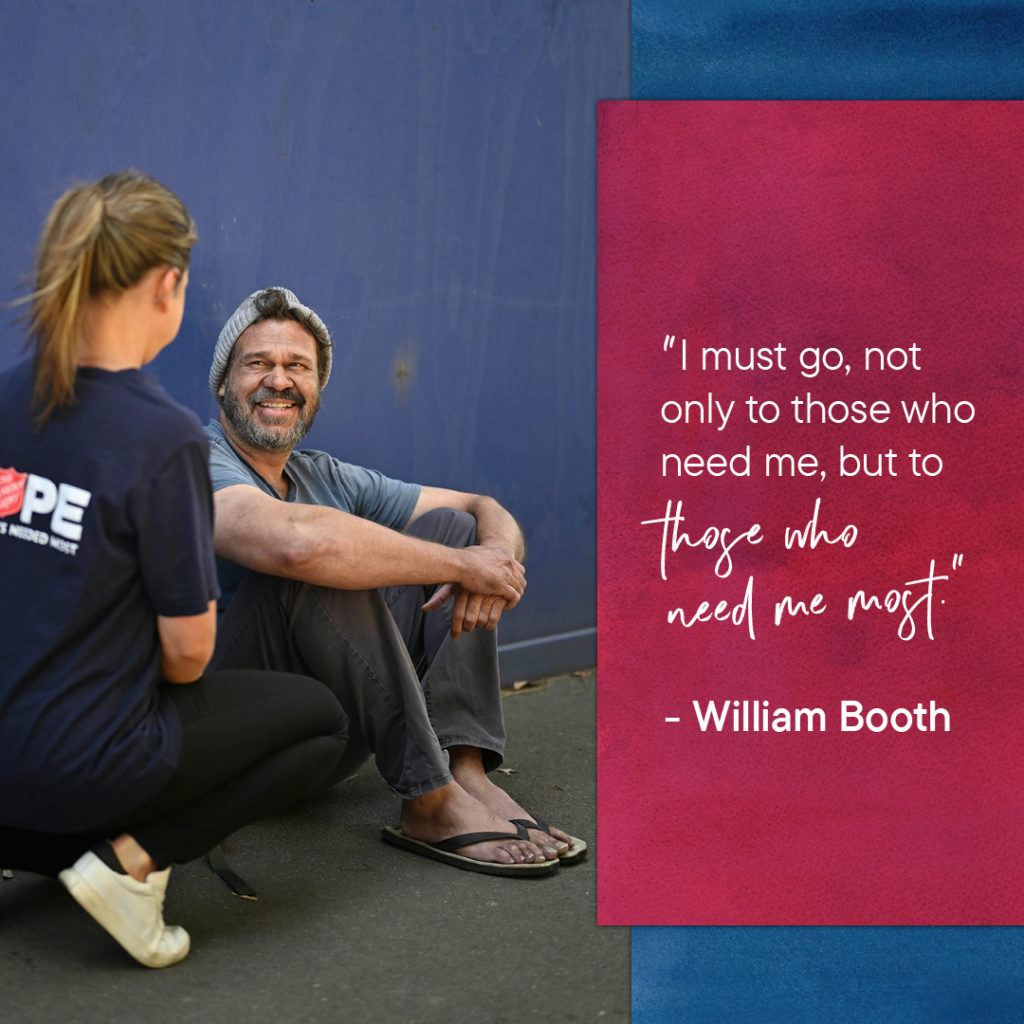
July 2nd is Founders’ Day, and is an opportunity to celebrate the legacy of General William and Catherine Booth, who founded The Salvation Army in London, England, in 1865. ⁣Celebrating 157 years of the Salvation Army helping those in need.

⁣William’s quote is a reminder of the vision that wherever there is hardship or injustice, the Salvos will live, love and fight, alongside others, to transform Australia one life at a time with the love of Jesus. ⁣

Salvation Army website

Categories
News Sandy's Comments

Nazi symbol prohibition

Victoria has become Australia’s first state to specifically ban the display of the Nazi swastika.

Sources
BBC
SBS News
The Age

Under a new law, the Summary Offences Amendment (Nazi Symbol Prohibition) Bill 2022, people who intentionally exhibit the symbol face up to a year in jail or a A$22,000 fine. The bill, hailed as a “thunderous blow” to white supremacists was passed in the Victorian Parliament on 21st June 2022.

The legislation was introduced in May 2022 to Parliament, when deputy opposition leader David Southwick, who is Jewish and has campaigned for the ban for a number of years, urged the government to have the new laws come into effect immediately.

The Bill was passed with bipartisan support.

Ros Spence, Minister for Multicultural Affairs, said, “These laws are part of our unwavering commitment to challenge antisemitism, hatred and racism wherever and whenever they occur.”

Victorian Premier Dan Andrews said “nobody has the right to spread racism, hate or anti-Semitism”. (Statement from Premier’s Department here).

Like many places globally, Australia has seen a sharp rise in anti-Semitic incidents in recent times.

Victoria already has anti-hate speech laws – but they have been criticised for having “gaps”. 

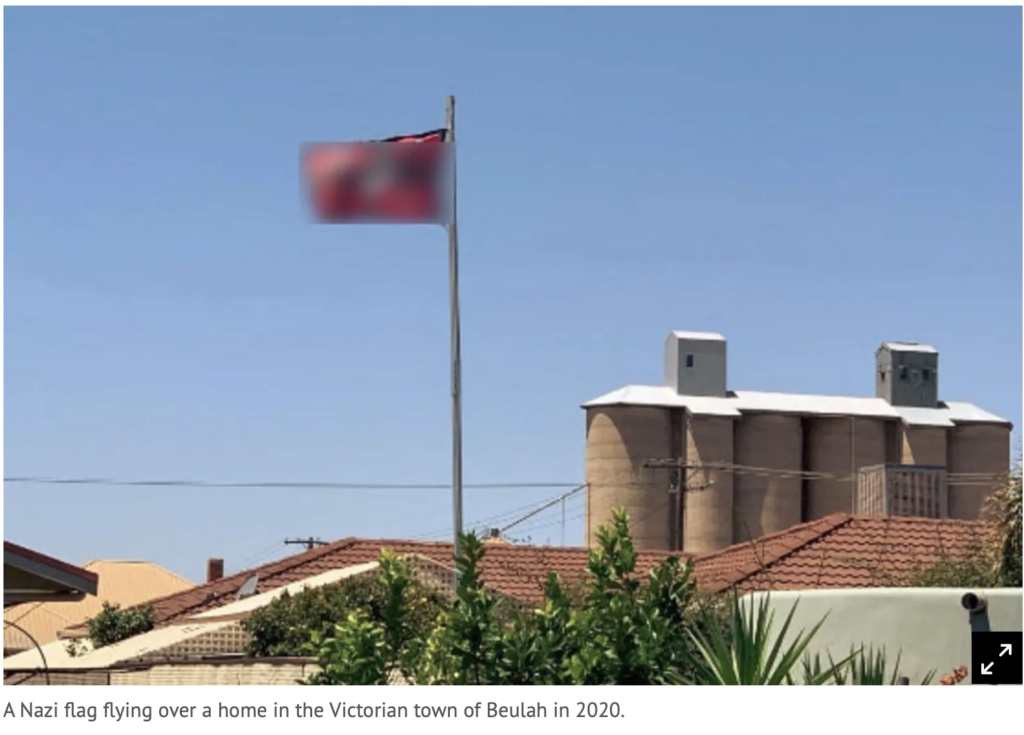
A push for reform intensified in 2020 when a couple raised a swastika flag above their home, angering the local community.

State officials called the new legislation a “proud moment”. Three other states have said they will introduce similar laws.

The Nazi swastika has become internationally recognised for representing anti-Semitism and racism after Adolf Hitler adopted it as the Nazi Party symbol in 1920.

“The Nazi symbol glorifies one of the most hateful ideologies in history – its public display does nothing but cause further pain and division,” said Victorian Attorney-General Jaclyn Symes. “It’s a proud moment to see these important laws pass with bipartisan support. I’m glad to see that no matter what side of politics, we can agree that this vile behaviour will not be tolerated in Victoria.”

There are exemptions for showing the symbol in historical, educational and artistic contexts. It can also be used in Hindu, Buddhist and Jain religious contexts, as it has been for millennia, where it represents peace and well-being.

Faith groups in Victoria have welcomed the state government’s decision to pass legislation banning the public display of the Nazi symbol.

Surinder Jain, Vice President of the Hindu Council of Australia says the Bill will help battle public confusion around the difference between the Nazi symbol and the ancient Indian swastika. “Because when we display it people misunderstand it to be the Nazi hate symbol Hakenkreuz – the hooked cross. This Bill makes a clear distinction between the two. It does the right thing by banning the hate symbol. And it does the right thing by exempting sacred symbols used by Hindus, Buddhists and Jains.”

“The bill will help battle public confusion around the difference between the Nazi symbol and the ancient Indian swastika”

(Surinder Jain, Vice President of the Hindu Council of Australia)

Victoria’s Jewish community also welcomed the bill. Chairman of the Anti-Defamation Commission (a Jewish organization founded to fight antisemitism) Dvir Abramovich began campaigning for the ban five years ago. He said a Jewish person being confronted by the Nazi swastika is “as threatening as being confronted by a gun”.

“I think people often forget what the Nazi swastika represents – the final solution. That is, the extermination of six million Jews in gas chambers. It represents the desire by the Third Reich to eliminate every single Jewish person on earth. It is the ultimate emblem of evil”.

Andy Meddick MP, addressing the Victorian Parliament, said: ‘This Bill today is not just about a symbol but about an ideology that took an ancient and respected symbol, perverted it, warped it and desecrated it so deeply that the world has come to see it almost exclusively as a symbol of a regime of such deep rooted hatred, murder, rape, genocide, and acts so vile that it’s hard to believe the human species could be capable of them”.

People will be prosecuted only if they defy a first request to remove the symbol.

Anti-Defamation Commission chairman Dvir Abramovich – who campaigned for the law – called it a “thunderous blow” to the neo-Nazi movement.

“As our nation confronts the deep stain of a resurgent white-supremacist movement that peddles a dangerous and dehumanising agenda, this parliament has declared that the symbol of Nazism will never find a safe harbour in our state,” he told the Australian Broadcasting Corporation.

The number of anti-Semitic incidents around the world dramatically increased last year, according to a study by Tel Aviv University. Australia had 88 in one month alone – a national record.

In 2020, Australia’s intelligence chief warned of a “real threat” to the country’s security from neo-Nazis. He said “small cells” of right-wing extremists were meeting regularly to salute Nazi flags and share their ideology.

Since the pandemic began, unions and others have also accused far-right groups of “infiltrating” large protests about lockdowns and other restrictions.

The new laws will come into effect in six months to allow for a campaign about the origins of the religious and cultural swastika to be rolled out. The government says it has brought forward the date when the legislation will come into effect, originally planned to take 12 months, based on feedback from religious, legal and community groups.

Categories
News Sandy's Comments

ABS 2011 Census

Find out what the (August) 2021 Census of Population and Housing data reveals about where we live, our ancestry and what languages we speak. 

10am, Tuesday 28th June 2022 at the National Portrait Gallery, Canberra and live streamed on Tuesday 28 June 2022 at 10:00am AEST. A link to the live stream will be made available on the ABS webpage.

If you are unable to tune in on the day, the launch will be recorded and available on the ABS website and the ABS YouTube channel after the event.

For the first time, the Census will also provide information about long term health conditions and service in the Australian Defence Force.

Presenters include:

  • Hon Dr Andrew Leigh MP, Assistant Minister for Competition, Charities and Treasury
  • Dr David Gruen AO, Australian Statistician
  • Professor Sandra Harding AO, Emeritus Professor, James Cook University and former Chair of the Australian Advisory Council (2001-2006)
  • Teresa Dickinson PSM, Deputy Australian Statistician and Senior Responsible Officer for the 2021 Census.

An audience question and answer session will follow from 10:30am AEST. A platform to ask questions will be available from this page until the end of the session. If you would like your name and organisation read out with your question, please add this to the top of your question. Questions will be moderated.

The ABS will release 2021 Census data in a staged approach. There will be three key release phases.

  1. 28 June 2022 – most topics will be released for almost all geographic outputs for place of usual residence and for place of enumeration on Census night.
  2. October 2022 – a smaller number of topics including employment and location-based variables will be released.
  3. Early to mid-2023 – complex topics that require additional processing such as distance to work, socio-economic indexes for areas (SEIFA) will be released.
Categories
News Sandy's Comments

A commitment to peace

(original post 15th June 2022)

Rev. Prof. Dr Ioan Sauca has been serving as acting general secretary of the World Council of Churches.

He reflects, “We all remember March 2020. The world went into lockdown as the COVID-19 pandemic spread across the globe.”

Yet the WCC has remained a vibrant fellowship of churches.

“Wars and conflicts have erupted in different parts of the world, bringing loss of lives, destruction, famine, dislocations of populations, refugees. At every step, it has been my prayer that the WCC can be a space for dialogue, for listening and caring for one another, and for just peace and reconciliation.”

As followers of Christ, we have been entrusted with the ministry of reconciliation. “It would be very easy to use the language of the politicians, but we are called to use the language of faith, of our faith. It is easy to exclude, excommunicate, and demonize, but we are called as WCC to use a free and safe platform of encounter and dialogue, to meet and listen to one another even if and when we disagree.”

This has always been the way of the WCC, he said. “I believe in the power of dialogue in the process toward reconciliation,” he said. “Imposed peace is not peace; a lasting peace has to be a just peace.”

War cannot be just or holy, he said. “In this time, until the end of my responsibility as acting general secretary that you have entrusted to me, I will not stop speaking against any aggression, invasion, or war, I will continue being prophetic, but I will do my best to keep the WCC what it was meant to be and to keep the table of dialogue open,” he said.

This upcoming 11th WCC Assembly in Karlsruhe has a focus on love, compassion, reconciliation, healing, and unity – even in the context of a global pandemic and war.

The WCC is at a turning point in history, Sauca concluded. “We need to stay together with strong bonds of love and commitment, our legacy for the period post-Karlsruhe being a strong and meaningful WCC.”